Landmark on Robson: Designing for Small Spaces
Written with insights by Alison Mazurek and Diana Ellis
There’s a common misconception that great design can only happen in a big floor plan. In our experience, small homes tell a different story. When space is constrained, design thinking sharpens. Every decision is more visible, and choices have to earn their place.
That was the brief at Landmark on Robson, a residential condo project in Vancouver’s West End. Designed for urban downsizers looking to simplify, alongside younger buyers entering the market, the display suites called for restraint, precision, and a certain discipline. The goal wasn’t to make the homes feel larger than they were, but to make them feel complete.
The result turned into something warmer and more personal. Buyers began purchasing them fully furnished, exactly as designed. They went on to be recognized at the SBID International Design Excellence Awards in London. Mostly, they proved something we’ve long believed:
small spaces reward good design.
Here are a few things they taught us.
Right-Size Everything, Especially the Furniture
In compact spaces, scale does most of the work. Rooms don’t feel tight because they’re small. They feel tight because the furniture is too big.
At Landmark, going smaller often made the space feel better. Love seats took the place of full sofas. Media consoles were edited down. Round dining tables left space to move comfortably around the room.
The same thinking applies to the details. Lamps, artwork, side tables. In a small home, scale shows up everywhere. When it’s handled well, everything feels calmer.
Go Custom Where a Standard Solution Won’t Work
Compact layouts come with quirks. Closets that open a little too wide. Columns that land exactly where you don’t want them. Windowless rooms that feel like a question mark.
One bedroom left no room for nightstands once the closet doors swung open. Rather than squeezing something in, we stepped back and asked what the room actually needed. The answer became a custom headboard with a slim ledge, perfectly proportioned for bedtime essentials. It looks intentional because it is.
In another unit, a windowless den became a fully built-out, mirrored dressing room. Residents liked it so much they started recreating it themselves.
And when a structural column disrupted the dining area, it didn’t get hidden. It got upholstered, wrapped into a banquette, and paired with a small round table. It’s now the best seat in the house.
Every Piece Has a Job to Do
Space is finite. And in small homes, pieces need to work a little harder.
At Landmark, that meant design elements pulling double duty without feeling out of place. Headboards that replace nightstands. Dining tables attached directly to kitchen islands. Wall‑mounted lighting that frees up surfaces and floor space. Even that structural column ended up doing more than one job.
When every piece pulls its weight, nothing feels excessive.
Find the Nooks. The Best Spots are Easy to Miss
Some of the most useful square footage in a small home is the part no one notices at first.
Before we place furniture, we look for what’s being ignored. A narrow gap beside the bed. A shallow recess in the hallway. A corner that doesn’t seem useful yet. At Landmark, those moments became desk nooks with shelving above, slim entry ledges for keys and mail, mirrors placed exactly where they could do the most work.
These aren’t dramatic gestures. They don’t draw attention to themselves. But they change how the home functions day to day. Often, they’re the things people end up appreciating most.
Let Materials and Light Do the Heavy Lifting
When square footage runs out, atmosphere steps in.
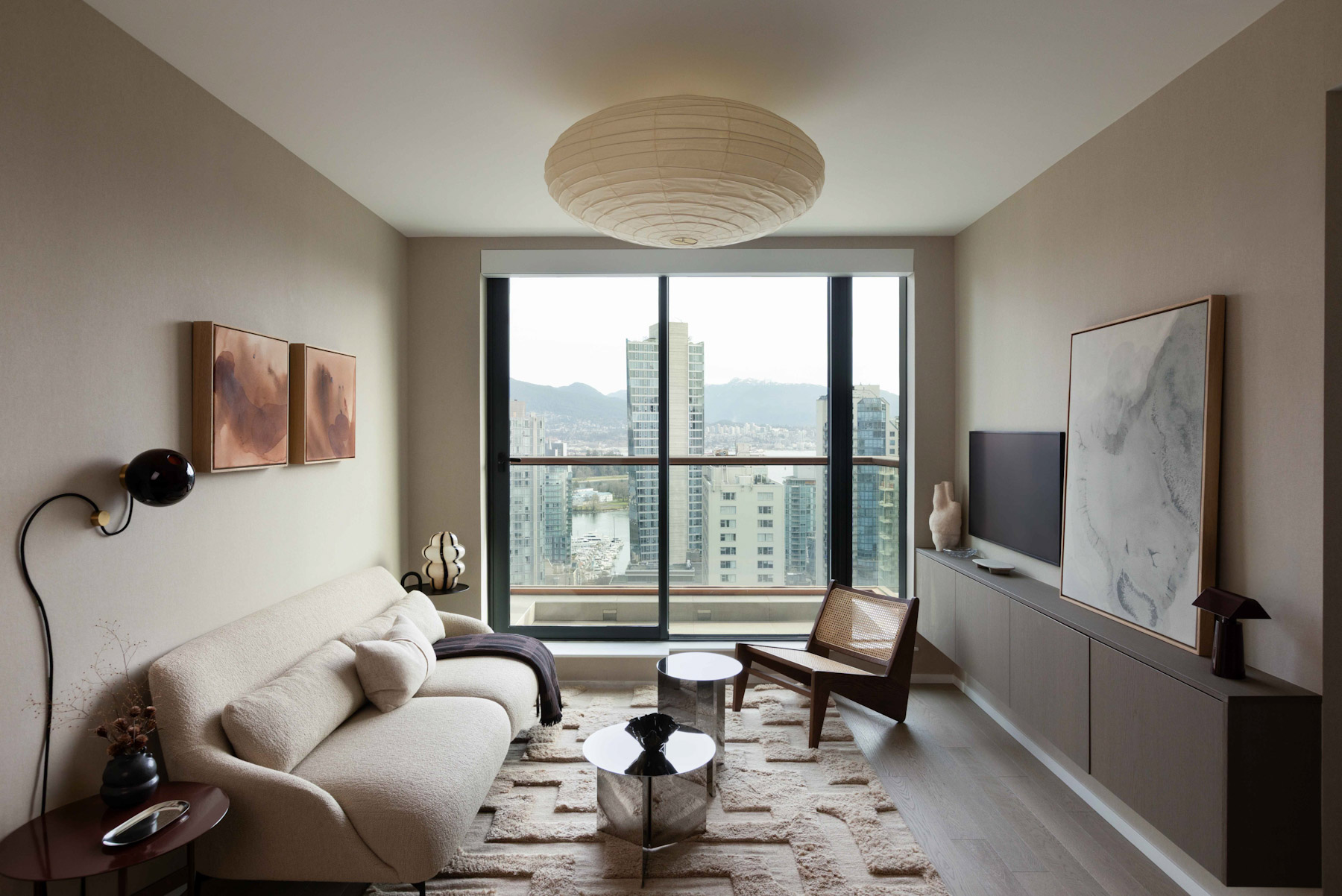
Rather than adding more furniture, the Landmark suites were layered with warmth through material choices. Textured wallcoverings softened the edges of a white‑box interior. Medium‑toned woods replaced pale finishes. Richer materials created depth without taking up space.
Lighting followed the same logic. In a small home, you don’t get many chances to make a statement, so each one counts. If there’s room for one lamp, it needs to be a good one. There’s nowhere to hide a poor choice, and no reason to make one.
The Takeaway
Small spaces reward clarity. When every decision is visible, design becomes more deliberate. Furniture is chosen with care. Millwork earns its place. Materials and finishes carry more responsibility.
Landmark on Robson reminded us that compact homes don’t ask for compromise. They ask for precision. Designed intentionally, the result is a space that feels composed, personal, and genuinely good to live in.